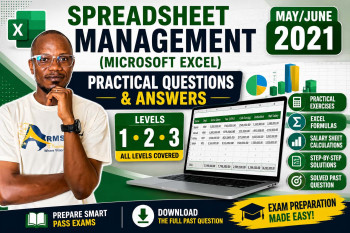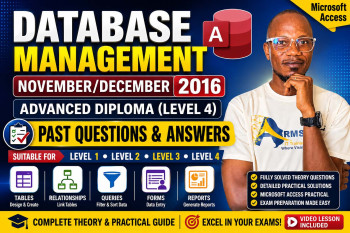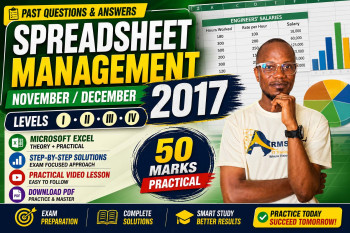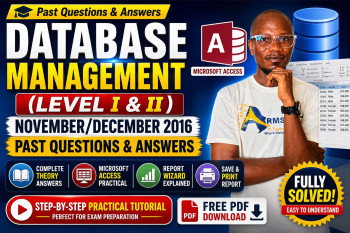
A Past Question Practice Blog to Help Students Understand Better
SECTION A: OBJECTIVE TEST
- Select the odd item
- a. Mouse - Input
- b. Keyboard - Output
- c. Hard Disk - Storage
- d. Switch - Internet
- Which is a Database Management System?
- a. MS Word
- b. MS Office
- c. Oracle
- d. Visual Basic
- Computer processing speed is measured in:
- a. Megabyte
- b. Gigabyte
- c. Mini herts
- d. Megahertz
- The wallpaper of a desktop can be changed:
- a. True
- b. False
- The temporary memory of the computer is:
- a. ROM
- b. RAM
- c. Hard drive
- d. Secondary memory
- The topmost bar of every window is:
- a. Menu
- b. Status
- c. Tools
- d. Title
- UPS stands for:
- a. Uninterrupted Power Supply
- b. Universal Preventing System
- c. Unilateral Processing System
- d. Uninterrupted Processing System
- Not a CPU specification:
- a. 2.8GHz Clock Speed
- b. 2MB Cache
- c. 4.2ms Rotation Latency
- d. 32-bit Word Size
- All documents opened are located in the:
- a. Title
- b. Tool
- c. Menu
- d. Task
- Not a network topology:
- a. Star
- b. Ring
- c. Bus
- d. Round
SECTION B: SPREADSHEET MANAGEMENT
- Mention THREE (3) advantages of spreadsheet:
- 1. Easy data organization and calculation
- 2. Quick data analysis using formulas
- 3. Visualization using charts and graphs
- Differentiate between Workbook and Worksheet:
- Workbook: The entire spreadsheet file containing one or more worksheets.
- Worksheet: A single page or sheet within a workbook.
SECTION B1: DATABASE MANAGEMENT
- Define the following:
- Tables: Database objects used to store data in rows and columns.
- Queries: Requests for information from the database.
- Reports: Formatted output of data based on queries or tables.
- List three (3) ways of creating a database in MS Access:
- 1. Using Blank Database
- 2. Using Templates
- 3. Importing from External Sources (Excel, SQL)
SECTION B2: WORD PROCESSING - COMPULSORY
Instructions: Type the following document exactly as shown below.
TRAINING IN ORACLE SOFTWARE
OBJECTIVE
By the end of the training participant will be able to:
- Navigate windows multi-user environment (Windows NT)
- Understand basic of relational database
- Basic security issue in Windows NT and Relational Database
- Record transaction affecting various debts portfolios
- Produce regular reports
- Manipulation of database to produce non-routine through SQL query language
- Introduction to unit
- Introduction to Windows 2000/NT
- Introduction to Oracle 8.1.6
- Introduction to Oracle 8.1.6 Administration
- Introduction to SQL
All Aid and Debt Management Personnel from:
- Management Unit
- Accounting Unit
- Margins: Moderate
- Orientation: Portrait
- Paper size: Letter
- Font: Arial Narrow, Size: 16
- Headings: Capital letters, Bold, Underlined
- Insert a clip art at bottom right
- Save as: TRORACLE
- Print your work