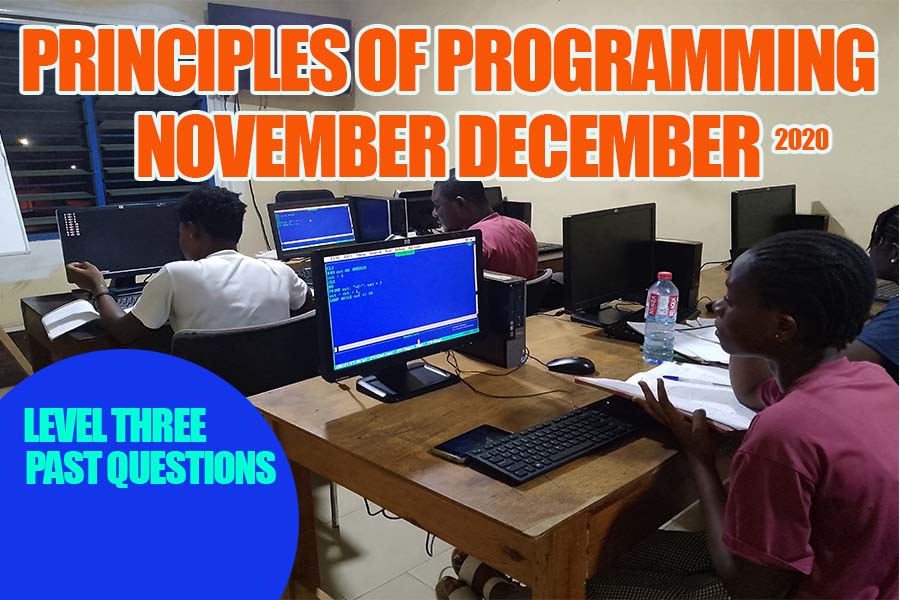
💻 Principles of Programming November December 2020 Level Three Past Questions 🎓 For students preparing for the Principles of Programming external examination, this blog post is a must-read! We at Armstrong Computers have curated a selection of past questions from the 2020 Level Three exam, including answers. Practicing with these past questions can greatly benefit your exam preparation, as it enables you to:
- Familiarize yourself with the types of questions that may be asked in the exam
- Strengthen your knowledge and understanding of programming concepts
- Develop problem-solving skills
🔁 You can download the past questions, test your knowledge, and improve your practical skills. Let us know your challenges in the comments section. We're always happy to help! 🤝
Armstrong Computers, is dedicated to providing quality education and resources for students. Remember, where vision meets excellence, success is inevitable! 🎉
- Theory Questions: Click on each question to reveal the answers and understand the concepts behind them.
- Practical Exercises: Download and solve the practical exercises to hone your spreadsheet management skills.
How to Use the Resources
- View Questions and Answers: Click on the past questions link to display each question along with its corresponding answer.
- Download for Offline Practice: Download the entire set of questions and answers for offline use, allowing you to practice and revise at your convenience.
- Solve and Review: Attempt to solve the questions on your own before reviewing the answers to gauge your understanding and progress.
INFORMATION AND COMMUNICATION TECHNOLOGY QUESTIONS
NOVEMBER / DECEMBER 2020
ICT LEVEL 3
SUBJECT: PRINCIPLES OF PROGRAMMING
SECTION A
Answer all questions.
- Java:- A versatile, high-level programming language that is widely used for building enterprise-level applications, web services, and Android apps.
- C++:- An extension of the C programming language, C++ supports both procedural and object-oriented programming and is used in system/software development and game programming.
- Python:- A high-level, interpreted language known for its readability and simplicity, often used in web development, data analysis, artificial intelligence, and scientific computing.
- C#:- Developed by Microsoft, C# is used for developing Windows applications, web applications, and games (using Unity).
A compiler is a software program that translates source code written in a high-level programming language into machine code or bytecode that a computer's processor can execute. The compilation process involves several stages, including lexical analysis, syntax analysis, semantic analysis, optimization, and code generation. The resulting executable code is then used to perform the tasks defined by the original program.
SQL (Structured Query Language) is a domain-specific language used for managing and manipulating relational databases. While SQL itself is not inherently object-oriented, it can be used in conjunction with object-oriented programming languages to interact with databases. In object-oriented programming, SQL queries can be embedded in the code to perform database operations like retrieving, updating, and deleting data. Object-oriented databases also exist that combine SQL with object-oriented features such as encapsulation, inheritance, and polymorphism to manage data in the form of objects.
Scope of a Variable:- The scope of a variable refers to the region of the program where the variable is defined and can be accessed or modified. There are generally two types of variable scopes:
- Local Scope:- Variables declared within a function or a block of code. They are accessible only within that function or block and are destroyed once the function exits or the block is completed.
- Global Scope:- Variables declared outside of any function or block. They are accessible from any part of the program and persist throughout the program's execution.
- Local Variables:- are used to store data that is only needed within a specific function or block of code. They help in encapsulating data and logic, preventing unintended interference or access from other parts of the program. Example: In a function calculating the sum of numbers, variables holding intermediate sums are local to that function.
- Global Variables:- are used to store data that needs to be accessed or modified by multiple functions or parts of a program.
They are useful for maintaining state or sharing data across the entire application.
Example: A global variable holding a configuration setting that is used by various functions throughout a program.
- Multiplication (*):- Used for multiplying two numbers. It has higher precedence than addition and subtraction.
- Division (/):- Used for dividing one number by another. It has the same precedence as multiplication.
- Addition (+):- Used for adding two numbers. It has lower precedence than multiplication and division.
- Subtraction (-):- Used for subtracting one number from another. It has the same precedence as addition.
Operators with higher precedence are evaluated before operators with lower precedence.
For example, in the expression 2 + 3 * 4, the multiplication is performed before the addition due to higher precedence of the * operator, resulting in 2 + (3 * 4) = 14.
- Integer (int):-Represents whole numbers without decimals. Used for counting or indexing.
- Float (float):- Represents numbers with fractional parts. Used for precise calculations with decimals.
- tring (str):- Represents sequences of characters. Used for text data.
- Boolean (bool):- Represents binary values True or False. Used for logical operations and conditions.
SECTION B
- Write a program that accepts N integers and calculate the total of them. Your program should print all the N numbers and the total on the display screen. Insert a comment as the first line of your program bearing your name and your index number.
- Save your work with your name and index number
- Print your source code